Showing posts with label Vampires in Pop Culture Feature. Show all posts

Sunday, October 27, 2013

Jonathan Rhys Meyers' Dracula Scorches the Small Screen


One of the promotional images for NBC's Dracula reboot describes it as "Old Legend. New Blood." They certainly delivered on that promise in last Friday's premiere episode. 

Dracula has been remade dozens of times since Bram Stoker first penned the novel in 1897. Each actor who played the part brought something new to the role. Every interpretation gave a new spin on the legend. This incarnation dusts off the old tropes and breathes new life into a story everyone thought they knew. 

I was aware going in that in order to create a season (hopefully multi-season) weekly drama based on a single novel, the writers would have to introduce new storylines to keep the audience tuned in. But what they created far exceeded my expectations. There are tons of surprises in store for even those who thought they knew everything there was to know about the characters. In addition, the production values are truly excellent, the costumes lavish, the acting superb, and the special effects are understated and powerful. 

The most effective special effect, however, is Meyers himself. The way his eyes glittered as he looked on Mina Murray from the shadows spoke volumes about the character of Dracula and hinted at things to come in a way that the script could never do. He has a power and charisma on screen that is incendiary, and it makes the audience root for him, even with the knowledge that he is not the hero. Or is he? I, for one, can't wait to find out. 
If you haven't seen the pilot episode, you're in for a treat. I plan to keep watching every week to see how the plot unfolds...and to see more of Jonathan Rhys Meyers. 

Tuesday, May 7, 2013

No Vampires in Pop Culture Feature this Week

This week is hectic in the extreme, but soon the semester will be over and I'll have a little breathing room to do the things I really need to get done. In addition to finishing Ma Chère Antoinne, I have some reviews to write, my garden to get in, some doctor's appointments, and I'll be moving into my new office upstairs at last (photos to come). My Vampires in Pop Culture Feature will be delayed until next week, but I plan to make it a great one.

In the meantime, enjoy the lovely spring weather with all its radiance and splendor.

Thursday, April 25, 2013

Vampires in Pop Culture Feature: Moonlight


Moonlight was only on for one season in 2007-2008, but what a season it was. Five years later, I still miss it, and the show still holds up even with time.

Private detective Mick St. John (Alex O'Loughlin) was smouldering in every scene and the chemistry between him and reporter Beth Turner (Sophia Myles) was hot enough to set the screen on fire.

I loved the back and forth "will-they-won't-they" each week, and the tension when Mick's ex-wife Coraline (Shannyn Sossamon) made an appearance kept me on the edge of my seat and desperate for answers. Just when I thought I hated her, I'd see something that made me wonder if she was really so bad as we'd been led to believe. If the show had been continued, I really hoped for more of her story.

But I have to say that my favorite character was none of the three corners of the love triangle but Mick's wisecracking rich sidekick, Josef Kostan (Jason Dohring). The wicked humor of Josef was a delight, and he always seemed to say just what the rest of us in the audience were thinking:

Josef Kostan: So, have you sealed the deal yet?
Mick St. John: It's not about sex.
Josef Kostan: Everything's about sex.
Mick St. John: I'm 52 years older than her, I drink blood bought from the morgue, and I tend to bite down when I...
Josef Kostan: Some women like that.
But Josef also showed a secret heart of gold and over the course of the season, it became clear why he and Mick were such close friends. His story was one I really was begging to hear, and it disappointed me that we only got a glimpse into his backstory.

Each episode of Moonlight was smart, sexy, exciting, and full of mystery. Mick's narration made it feel like an old time detective story, but with a supernatural twist that made it fresh and unpredictable. The writers managed to make a show that was full of surprises, and when I heard that CBS had decided to cancel it before it really had enough time to reach its potential, I was really disappointed. I think they missed out on a great opportunity by not taking a chance on a vampire mystery/romance. The same year, True Blood premiered on HBO, and obviously, audiences were quite willing to watch and keep coming back for more. Moonlight could definitely have given it a run for it's money if CBS had been willing to take a chance on it.

Episodes of Moonlight are available on DVD or can be downloaded from Amazon, Netflix, or iTunes. If you missed it, you're in for a real treat. And if you haven't seen it in a while, it's definitely worth rewatching.

Thursday, April 18, 2013

Vampires in Pop Culture Feature: The Vampyre

Vampires have been a part of human mythology since before recorded history. However, they were generally shown as inhuman, ravenous monsters rather than the more mysterious and sexualized creatures of the night as we think of them today. That change is due in large part to a novella entitled The Vampyre written in 1819 by Dr. John Polidori.

Polidori was not originally an author. He was a physician, and a young one at that, earning his degree from the University of Edinburgh at the age of 19. Being an attractive prodigy, he caught the eye of the poet, Lord Byron, who hired him on as his personal physician and took him to Europe.

Byron was by then very famous throughout the continent, and the scandal of his divorce and speculation about his sexuality was rampant. Publisher John Murray offered Polidori 500 pounds to keep a journal of his travels with the poet. This journal became a source of contention between Polidori and Byron, who was on the one hand flattered by the attention and on the other annoyed and angered by the intrusion into his privacy. There has been speculation that Polidori and Byron became romantically entangled. Certainly, Polidori was fascinated with the famous poet, but whether the feeling was mutual is debatable.

During their travels, they spent time in Geneva, Switzerland, and in the summer of 1816 they met the poet, Percy Bysshe Shelley, and his soon-to-be-wife, Mary Godwin, and Mary's stepsister, Claire Clairmont. Shelley and Byron became fast friends. Due to the explosion of Krakatoa, the weather that year was frigid, and they were forced to stay indoors for much of the time. To entertain themselves, the group told ghost stories, and Byron suggested a writing contest to pass the time. Shelley's story was published posthumously along with a portion of his journal. Mary Godwin began and later published Frankenstein, the first real science fiction story ever written in English. Byron's own story was abandoned, but Polidori took the basic elements of that fragment and wrote what became one of the very first English vampire stories--The Vampyre.

Byron and Polidori quarrelled, partly because Byron felt Polidori had puffed up airs, delusions about becoming a famous author, and was not content with doing the job which he had been hired to do. He found Polidori's personality irritating, and Byron's journal is full of dismissive and acerbic references to Polidori's shortcomings. Byron also feared that Polidori's journal would expose too many of his secrets. Thus, Polidori was dismissed from his position. Devastated, he traveled through Italy and then returned to England, where his book was published two years later.
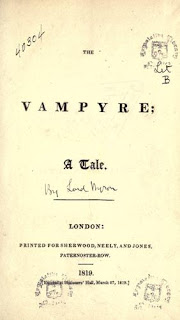
The main character of The Vampyre, Lord Ruthven, is pretty clearly based on Byron himself. Though Polidori had intended the book as a thinly veiled attack on the poet and a warning about his predatory nature, that intent backfired. In fact, the book was initially credited to Byron, a fact which irritated them both but which surely increased the sales of the story tremendously. The name Ruthven came from a character in a novel by Byron's famously spurned former lover, Lady Caroline Lamb, entitled Glenarvon, and Polidori intended it as a reminder to the readers of the scandal surrounding the poet.

Ruthven, the vampyre, is seductive and deadly. He is strong, masculine, handsome, and sneering at those he feels are beneath him. Readers today will recognize the basis for the English literary vampires which followed, including Dracula. Ruthven is a romantic, alluring, and devastating character who cuts a swath through a room full of women like a hot knife through butter.

On the other hand, the other main character, Aubrey, who finds himself drawn to Ruthven and who observes the terrible effects of being close to him, is meant to be a sympathetic character and most scholars agree that Polidori identified that character as being like himself. There is a clear (at least in my mind as a reader) homosexual subtext to the work, and Aubrey is drawn to Ruthven and seems most angered at the fact that Ruthven chooses young women as his victims rather than noticing him as a potential suitor. Aubrey comes off to me as a sad and bitter man who wishes he were smart enough, handsome enough, strong enough and who fails miserably. In the end, that is the impression which Polidori himself makes as well.

In trying to ruin Byron's reputation, Polidori only added to his fame. The novella was made into a French play the very next year and later into two operas.

As for Polidori himself, he committed suicide in 1821, leaving behind a string of gambling debts. His sister Charlotte transcribed his diary, omitting anything that might embarrass her family (which likely included anything relating to a possible relationship with Byron), and then she destroyed the original.

Whatever you might feel about the author himself, the book itself is a classic. The character of Ruthven is an archetype and serves as a model for all vampire authors who have followed.

The Vampyre is available as a free e-book through Project Gutenberg (http://www.gutenberg.org/ebooks/6087).

Friday, April 12, 2013

Vampires in Pop Culture Feature: Forever Knight

IMDb's listing for Forever Knight describes the show this way:
"A drama about an 800 year old, angst ridden vampire who lives in present day Toronto as a homicide detective in an attempt to repay for his sins and regain his mortality, with the aid of Natalie Lambert, a mortal coroner, while trying to keep his secret from his partner. His quests are hindered by his tormented past and his seductive 2000 year old master, Lucien Lacroix."
I remember watching Forever Knight back in the early 90s, and it was kind of a guilty pleasure for me. During the third and final season, I was in graduate school studying English Literature, and I felt as though I was somehow sneaking around to watch it when no one else would know, as though it were my dirty little secret.

But oh, how I loved that show. How I longed for Nick Knight to be redeemed. And how I longed for him and Natalie to make things work between them. Their romance was heartbreaking, and I loved every minute of it.
Nick: Don't. Don't get too close to me.
Natalie: Why? You want to hurt me? Kill me?
Nick: No. But I might anyway.

When the show went off the air, I was so disappointed. I loved the poignant ache of Nick's character, and I suppose in some ways the way that Geraint Wyn Davies portrayed him informed the way I've written one of my novel Ma Chère Antoinne's main characters, Raul Griffin. They both share a sort of tragic desire to change what cannot be changed, to go back to being human in order to be with the women they love.

Janette, Nick's former vampire lover, struggles to understand why he doesn't appreciate the gift he's been given, and Nick's master, Lucien Lacroix, was devastatingly sinister yet alluring at the same time. Lacroix seemed to have Nick in a trap that he could never escape from, no matter how much he longed to be free. I loved his musings on the meaning of life, and while they were chilling, they also made a great deal of sense, and it was easy to understand how someone like Nick would be persuaded to follow him.
Lucien LaCroix: Life is a gift. As sweet as a ripened peach, as precious as a gilded jewel. I've never understood the logic of willfully surrendering such a treasure. And what is there to gain? How dark can your existence be when compared to an empty void? Unless of course, you have faith that there is something beyond. What do you see from where you stand? A bright light at the end of the tunnel? Is it a ray of hope? A glimmer of something better? Or will it burn you like the rising sun? Is that sound you're hearing the trumpeting of St. Peter's angels, or the screams of Memnoch's tortured souls? You can't answer that, can you, because you will never know the answer, till the deed is done. And is your faith really that strong? I understand the need to move on, it is something that happens, and your time has truly come. I also understand that with the beauty of this life there comes pain and despair. No one is immune. But consider what is in your hands. Don't trade a treasure for an empty box. 

Nick's struggle was so very painful, and yet I could not stop watching. I never let go of my hope for him, even at the last.

If you have never seen the show, I highly recommend it. It's available on DVD and can be downloaded or streamed from iTunes, Netflix, or Amazon.