Showing posts with label vampires. Show all posts

Sunday, January 19, 2014

New Normal

If you want to be taken seriously, be consistent."
I saw this quote yesterday on a friend's page, and though she was referring to her fitness regimen, it spoke to my beliefs about writing too.

Some of the people in my life, when they heard that I had sent my book off to an agent, said "Oh good! Now you can have your free time back." And I realized that they saw my writing as a chore, something I undertook as a project, and now the first manuscript is finished, they saw the chore as something I could tick off my to-do list and finally have time for "fun."

But the thing is that writing IS fun for me. It's not a chore. Well, okay, there are days when it's easier than others. Still, writing is something I enjoy. And it's an ongoing thing. I'm a writer, and that word encompasses the ongoing nature of the action. For me, it's not something I do once and then I'm finished. It's part of who I am. It's something that's integral to my nature. I've always done it. The difference is that in the past it was something I hid from others. It was a private activity that I did late at night after everyone else was asleep. I had this feeling that I wasn't allowed to be serious about it. I had to have a full-time job and there were responsibilities and obligations and to-do lists of chores. So my writing became like an indulgence. Something I allowed myself to do as a privilege whenever I finished everything else. It was a luxury the way other women dream of bubble baths and manicures and trips to the spa. And I was able to indulge that luxury about as often as most women get to have those other things.

It's amazing to me that, given the sidelining of my dreams, I still managed to write anything at all. And yet, I have amassed a great deal of writing in spite of all that. I dreamed of being a writer since I was a little girl, but I allowed that dream to shrink while other things took control of my time.

This last year was the first time that I decided to stop relegating my writing to the margins of my life. I feel as though I finally allowed my true self to step forward and reclaim the importance it deserves. It's the first time that I let myself think of writing as a true vocation.

I've been writing my whole life. People just never saw it before now. But I'm through hiding it. This is my new normal. I'm not apologizing for it.

"If you want to be taken seriously, be consistent." That means setting a schedule. Following through on what I plan. Writing every day not as an afterthought or a late night indulgence but as a priority.

_________________________________________

Here at the beginning stages of Book 2, I have some research to do to prepare for the world I'm creating. I'm not sure yet how much of that research will yield rules I will incorporate vs. those I'll deliberately break, but I think it's important that I remind myself what the traditional rules have been before I go making new ones of my own.

These are a couple of the books I'm looking through. 


I also found some very interesting information from my History of Magic and Experimental Science books (mentioned before here) regarding vampire lore, spanning back to the Greeks and Romans. Fascinating stuff! One passage refers to the Lamias, female vampiric figures I've studied before.


I'm thoroughly enjoying the research, and I'm certain that the information will be useful.

_________________________________________

One of the improvements I've made since I began work on this series a year ago is the use of Evernote to collect my notes, inspiration, and scraps of ideas for future reference. Evernote allows me to keep all of my ideas together and share them from my desktop to my iPad to my phone seamlessly.  I can use tags to make searching for data simple, and so far it's really helped me organize my work. Often, I'll be walking to work and think of something that I might add to my book somehow. With Evernote, I can save it all in one place, and those ideas are never lost. Research, character notes, photos, links...all collected for me. I love it.

Monday, January 13, 2014

Random Interesting Stuff (or How I Cut My Distractions and Got Busy Writing Book 2)

How to Break Through Your Creative Block by Maria Popova for Brain Pickings
I'm working on this. I get easily distracted and sidetracked with to-do lists and social media, and then the next thing I know I'm taking a nap. My solution is two-fold.
  1. This blog is going to be my repository of distracting but interesting stuff. Rather than posting several times a day, I'm going to try to limit myself to a few posts at the beginning and end of the day, saving up interesting ephemera for one single blogpost every day or so.
  2. When I'm staring at a blank page or screen, unsure how to start, I take about 5-10 minutes and do a prewriting just to get things rolling. Instead of worrying about how I'm going to say just the right thing, I start instead with writing about what I'm going to write about. I don't worry about grammar or paragraph breaks or any of that. Sometimes it's just a list. But I'm thinking about the scene and what I want to have happen. By the time I've told myself what I'm going to tell, it's easy to start telling it. The hard work is done.

Why Dogs Make Fun Writing Partners by Jennifer Robson for Writer's Digest
I loved this article, and I couldn't agree more. Layla needs a break about as often as I need a new cup of coffee, so that's a partnership that works. Plus, she keeps my feet warm. I keep her bed right behind my chair, though she often chooses to lie down under my desk or on the rug at my side. She's a good companion since she doesn't say much but is an excellent listener.

"The Poisoner's Handbook," American Experience . WGBH | PBS
My high school English teacher sent me a link to this video on Facebook, and it was definitely worth watching. I've always loved murder mysteries and true crime, so it was interesting to me to see the development of this end of CSI work.

Vampires: Folklore, fantasy and fact - Michael Molina 
 

I don't think I really need to explain why I find this short video sent to me by a friend so fascinating and fun.

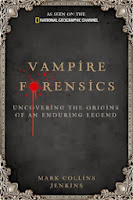
    Vampire ForensicsVampire Forensics
    I bought this book for my Kindle, and I'm really enjoying the details inside. Though I can't reveal just how (spoilers!), there are definite ways this book will inform some of the things that happen in Book 2. As a reader, I always like knowing that an author has done his/her homework, so I want to be sure I'm following through on that expectation too.

    I've got a few more books on their way, and I'll be doing some book reviews once I'm finished reading for those who are interested in vampire lore and history.


      History of Magic and Experimental Science
      I bought this set of books at the last library book sale. None of them had been read in 30 years or more, but the title alone is fascinating. It's an encyclopedic study of how superstitions about witchcraft and alchemy developed over the course of several centuries into what we now call the sciences.

      These books are far too lengthy for me to read straight through beginning to end, but they are wonderful to dip in and out of. Vampires and other supernatural creatures are discussed throughout history, beginning with the Greek NeoPlatonists. Creepy geeky goodness. There are certainly ways in which I will be using information found here.

      Sunday, October 27, 2013

      Jonathan Rhys Meyers' Dracula Scorches the Small Screen


      One of the promotional images for NBC's Dracula reboot describes it as "Old Legend. New Blood." They certainly delivered on that promise in last Friday's premiere episode. 

      Dracula has been remade dozens of times since Bram Stoker first penned the novel in 1897. Each actor who played the part brought something new to the role. Every interpretation gave a new spin on the legend. This incarnation dusts off the old tropes and breathes new life into a story everyone thought they knew. 

      I was aware going in that in order to create a season (hopefully multi-season) weekly drama based on a single novel, the writers would have to introduce new storylines to keep the audience tuned in. But what they created far exceeded my expectations. There are tons of surprises in store for even those who thought they knew everything there was to know about the characters. In addition, the production values are truly excellent, the costumes lavish, the acting superb, and the special effects are understated and powerful. 

      The most effective special effect, however, is Meyers himself. The way his eyes glittered as he looked on Mina Murray from the shadows spoke volumes about the character of Dracula and hinted at things to come in a way that the script could never do. He has a power and charisma on screen that is incendiary, and it makes the audience root for him, even with the knowledge that he is not the hero. Or is he? I, for one, can't wait to find out. 
      If you haven't seen the pilot episode, you're in for a treat. I plan to keep watching every week to see how the plot unfolds...and to see more of Jonathan Rhys Meyers. 

      Friday, June 21, 2013

      New Orleans World Horror Convention Wrap Up

      I spent last week in New Orleans, attending the World Horror Convention. In addition to making some new friends, I also pitched my book and sat in on several great panel discussions that taught me a lot about the market and about genre publishing.

      The Hotel Monteleone

      Fantastic Swag from the WHC

       
      Video of some of the things I saw/did in New Orleans

      The pitch sessions went extremely well. I've sent off my manuscript to three different people, and now the waiting begins. Hopefully, I'll know something in a month or so.

      In the meantime, I'm going to be working on Book 2 (still untitled), and trying to get ahead on that while I've got my momentum going. I also want to get as much done as possible before the summer is over. Once the fall semester starts, I'll have to slow down a little on my writing once more in order to keep up with my other obligations.

      The next book has already been outlined, and I've written up a plan for the chapters. Of course, as I write, the characters may lead me in ways I haven't anticipated, but that's what I love. I have some new characters added into the mix that I think people will really enjoy, and I'm doing a great deal of research to prep my mind for what lies ahead.
      • Of course, I've got a lot of background info for my characters. I never like to be too tied to literal facts when the story can benefit from embellishment, but I do think it's absolutely essential to read as much as I can about the real lives of the people I'm writing about before I just start making stuff up. Then again, they are vampires, so you can't expect everything to be factual in every detail. This is fiction, not biography.
      • I'm also going to be taking a course in forensics over the fall semester, which I'm extremely excited about. I've already bought the book and have taken tons of notes, poring through it in detail. I think it will enhance what I've already written and open up new avenues throughout the series.
      The entire experience left me feeling even more energized to keep working and improving and moving forward with the next part of the story. I hope that in the next few weeks and months to have some exciting news. Whether or not a publishing deal comes out of the convention, I'm more determined than ever that if those three people aren't interested, I will find the folks who are. Patience and hard work will eventually pay off.

      Saturday, May 4, 2013

      FREE! Cinco De Mayo Special this Sunday!

      ONE DAY ONLY!

      On Sunday, May 5, the Sneak Peek Edition of my upcoming novel, Ma Chère Antoinne, is free on Amazon Kindle!

      If you haven't read it, there's no better time to check it out! And if you already have your copy, share it with your friends! It's free all day! 

      Click here to download:
      Sneak Peek Edition, Ma Chère Antoinne

      Thursday, April 25, 2013

      Vampires in Pop Culture Feature: Moonlight


      Moonlight was only on for one season in 2007-2008, but what a season it was. Five years later, I still miss it, and the show still holds up even with time.

      Private detective Mick St. John (Alex O'Loughlin) was smouldering in every scene and the chemistry between him and reporter Beth Turner (Sophia Myles) was hot enough to set the screen on fire.

      I loved the back and forth "will-they-won't-they" each week, and the tension when Mick's ex-wife Coraline (Shannyn Sossamon) made an appearance kept me on the edge of my seat and desperate for answers. Just when I thought I hated her, I'd see something that made me wonder if she was really so bad as we'd been led to believe. If the show had been continued, I really hoped for more of her story.

      But I have to say that my favorite character was none of the three corners of the love triangle but Mick's wisecracking rich sidekick, Josef Kostan (Jason Dohring). The wicked humor of Josef was a delight, and he always seemed to say just what the rest of us in the audience were thinking:

      Josef Kostan: So, have you sealed the deal yet?
      Mick St. John: It's not about sex.
      Josef Kostan: Everything's about sex.
      Mick St. John: I'm 52 years older than her, I drink blood bought from the morgue, and I tend to bite down when I...
      Josef Kostan: Some women like that.
      But Josef also showed a secret heart of gold and over the course of the season, it became clear why he and Mick were such close friends. His story was one I really was begging to hear, and it disappointed me that we only got a glimpse into his backstory.

      Each episode of Moonlight was smart, sexy, exciting, and full of mystery. Mick's narration made it feel like an old time detective story, but with a supernatural twist that made it fresh and unpredictable. The writers managed to make a show that was full of surprises, and when I heard that CBS had decided to cancel it before it really had enough time to reach its potential, I was really disappointed. I think they missed out on a great opportunity by not taking a chance on a vampire mystery/romance. The same year, True Blood premiered on HBO, and obviously, audiences were quite willing to watch and keep coming back for more. Moonlight could definitely have given it a run for it's money if CBS had been willing to take a chance on it.

      Episodes of Moonlight are available on DVD or can be downloaded from Amazon, Netflix, or iTunes. If you missed it, you're in for a real treat. And if you haven't seen it in a while, it's definitely worth rewatching.

      Thursday, April 18, 2013

      Vampires in Pop Culture Feature: The Vampyre

      Vampires have been a part of human mythology since before recorded history. However, they were generally shown as inhuman, ravenous monsters rather than the more mysterious and sexualized creatures of the night as we think of them today. That change is due in large part to a novella entitled The Vampyre written in 1819 by Dr. John Polidori.

      Polidori was not originally an author. He was a physician, and a young one at that, earning his degree from the University of Edinburgh at the age of 19. Being an attractive prodigy, he caught the eye of the poet, Lord Byron, who hired him on as his personal physician and took him to Europe.

      Byron was by then very famous throughout the continent, and the scandal of his divorce and speculation about his sexuality was rampant. Publisher John Murray offered Polidori 500 pounds to keep a journal of his travels with the poet. This journal became a source of contention between Polidori and Byron, who was on the one hand flattered by the attention and on the other annoyed and angered by the intrusion into his privacy. There has been speculation that Polidori and Byron became romantically entangled. Certainly, Polidori was fascinated with the famous poet, but whether the feeling was mutual is debatable.

      During their travels, they spent time in Geneva, Switzerland, and in the summer of 1816 they met the poet, Percy Bysshe Shelley, and his soon-to-be-wife, Mary Godwin, and Mary's stepsister, Claire Clairmont. Shelley and Byron became fast friends. Due to the explosion of Krakatoa, the weather that year was frigid, and they were forced to stay indoors for much of the time. To entertain themselves, the group told ghost stories, and Byron suggested a writing contest to pass the time. Shelley's story was published posthumously along with a portion of his journal. Mary Godwin began and later published Frankenstein, the first real science fiction story ever written in English. Byron's own story was abandoned, but Polidori took the basic elements of that fragment and wrote what became one of the very first English vampire stories--The Vampyre.

      Byron and Polidori quarrelled, partly because Byron felt Polidori had puffed up airs, delusions about becoming a famous author, and was not content with doing the job which he had been hired to do. He found Polidori's personality irritating, and Byron's journal is full of dismissive and acerbic references to Polidori's shortcomings. Byron also feared that Polidori's journal would expose too many of his secrets. Thus, Polidori was dismissed from his position. Devastated, he traveled through Italy and then returned to England, where his book was published two years later.

      The main character of The Vampyre, Lord Ruthven, is pretty clearly based on Byron himself. Though Polidori had intended the book as a thinly veiled attack on the poet and a warning about his predatory nature, that intent backfired. In fact, the book was initially credited to Byron, a fact which irritated them both but which surely increased the sales of the story tremendously. The name Ruthven came from a character in a novel by Byron's famously spurned former lover, Lady Caroline Lamb, entitled Glenarvon, and Polidori intended it as a reminder to the readers of the scandal surrounding the poet.

      Ruthven, the vampyre, is seductive and deadly. He is strong, masculine, handsome, and sneering at those he feels are beneath him. Readers today will recognize the basis for the English literary vampires which followed, including Dracula. Ruthven is a romantic, alluring, and devastating character who cuts a swath through a room full of women like a hot knife through butter.

      On the other hand, the other main character, Aubrey, who finds himself drawn to Ruthven and who observes the terrible effects of being close to him, is meant to be a sympathetic character and most scholars agree that Polidori identified that character as being like himself. There is a clear (at least in my mind as a reader) homosexual subtext to the work, and Aubrey is drawn to Ruthven and seems most angered at the fact that Ruthven chooses young women as his victims rather than noticing him as a potential suitor. Aubrey comes off to me as a sad and bitter man who wishes he were smart enough, handsome enough, strong enough and who fails miserably. In the end, that is the impression which Polidori himself makes as well.

      In trying to ruin Byron's reputation, Polidori only added to his fame. The novella was made into a French play the very next year and later into two operas.

      As for Polidori himself, he committed suicide in 1821, leaving behind a string of gambling debts. His sister Charlotte transcribed his diary, omitting anything that might embarrass her family (which likely included anything relating to a possible relationship with Byron), and then she destroyed the original.

      Whatever you might feel about the author himself, the book itself is a classic. The character of Ruthven is an archetype and serves as a model for all vampire authors who have followed.

      The Vampyre is available as a free e-book through Project Gutenberg (http://www.gutenberg.org/ebooks/6087).

      Sunday, March 3, 2013

      What RolePlay Taught Me About Writing

      For the last four years, I have been a member of a large True Blood roleplaying group across several online sites--Facebook, Twitter, Tumblr. The group I'm a part of has been writing one continuous storyline spanning that entire time. Some people dedicate themselves to creating one specific character, while others play several roles on an as needed basis. All of the people in the group are talented, creative, funny, and fascinating, and in that four years working with them to tell stories, I have learned a lot about writing. It's a great training ground for writers to develop their own voice and style. It's also wonderful practice in an environment that makes learning fun for everyone.

      Lessons I've learned through RP:

      1. Writing doesn't have to be solitary. RP is a fantastic chance to collaborate with others, and it has taught me how to write alongside someone else. I would love to have the chance to write a short story or novel as a joint project with another author, because I have learned how to listen, how to share, and how to expand my own ideas by listening to others.
      2. Accepting constructive criticism is essential and the editing process should be collaborative and non-threatening. RP is all about listening to others and seeing another side to a project you're working on. If you're going to work with others on a storyline, you have to be willing to listen to their ideas, suggestions for improvements, and be grateful when they notice spelling errors or plot holes or ways the story should be expanded or cut for clarity. Working with an editor is the same process. The editor should be someone the writer collaborates with, not someone who is seen as a threat. Your ego as a writer has no place in the editorial process. It's essential to realize that the editor is there to help you improve your story, not take away your voice.
      3. Planning your storyline is essential to the writing process. When writing long RP storylines, the group I work with always has an outline for large group RPs so everyone knows his/her role in the plot and can keep track of what's happening with the other characters. We schedule events and plan how long it will take to write each part. This type of organized plotting is essential for writers. Currently, I'm writing a mystery, and in order to complete the novel on time and to make sure that I give the right clues at the right moment in the plot, every chapter has to be carefully planned. I know approximately how many pages each chapter is, when I'm dropping the next cliffhanger/clue, and what each character is doing in every scene.
      4. The key to having great characters is having a detailed character description before you ever begin writing. In RP, if you're going to make the role you're playing believable, you have to know that character inside and out. What makes the person tick? What are their fears, motivations, and goals? What is the person's backstory that leads them to the place where he/she takes part in the plot? What is going to be the final outcome for the character in the storyline? How does he/she interact with the other characters? All these same questions must be answered when writing any type of fiction. If my characters are going to be believeable, I have to know every detail of their lives. Otherwise, their actions will seem false to readers and will throw off the rest of the story.
      5. Cliffhangers keep people coming back for more. Our RP group has several "fans" who follow our characters' storylines. The key to maintaining their interest in what's happening is having a cliffhanger with nearly everything we write. Whether it's a short paragraph teasing the next big plot or a long group RP, every story ends with a cliffhanger. The same is true in fiction writing. Cliffhangers keep people coming back for more. They want to know what's going to happen next. It makes them think about possible scenarios for how things might play out.
      6. Interacting with the audience/readers is the number one most effective way to keep them coming back for more. Readers of our RP group love getting to interact with us, either in comments on our story posts or inboxes asking about the next storyline. They love getting the chance to talk to us both in and out of character and feeling like they have inside understanding of us as a group. And they like joining in active online formats for talking with both you and other readers. The same is true for fiction writers. If you want to maintain and grow an audience for your writing, get to know our readers. Talk to them. Interact with them. Give them places and ways to share with you and with one another. If they feel a connection with you personally, then they're not only more likely to keep reading what you write, but they're also likely to tell others about you and help you find new readers. They will share your links, your photos, your information, and help you increase your visibility. They will talk with one another about you, about your posts, about things that you all have in common. It will also increase your audience's sense of group identity and the likelihood that you will have a fan base who have a sense of pride in your success.
      7. Your only limitations are your own imagination. In my RP group, we write across several "verses," combining characters from True Blood, Buffy the Vampire Slayer, The Walking Dead, Interview with a Vampire, General Hospital, Doctor Who, and many more right alongside original characters who take part in the action as well. If someone can justify the character and make the actions believable within the storyline, they are free to let their imagination soar. The same should be true of fiction writing. The only limitation is yourself. As long as what you write has an internal logic within the universe you're creating, then there is no limit to what you can create.